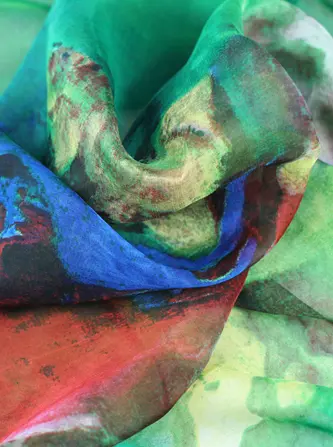
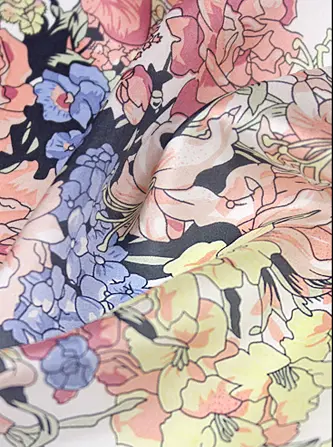
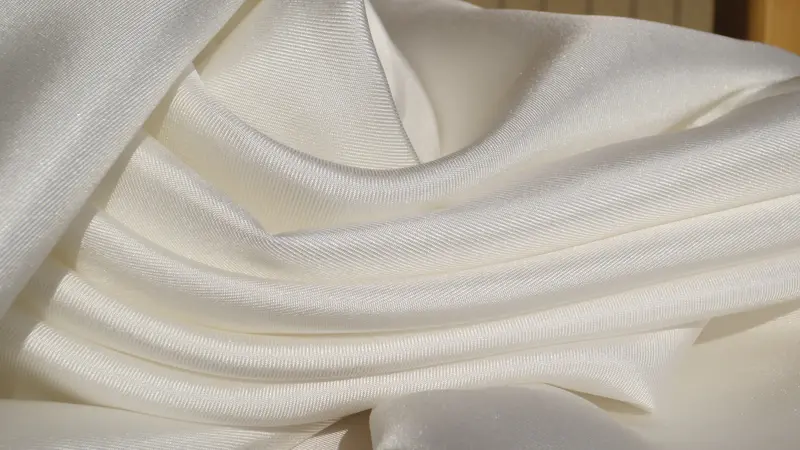
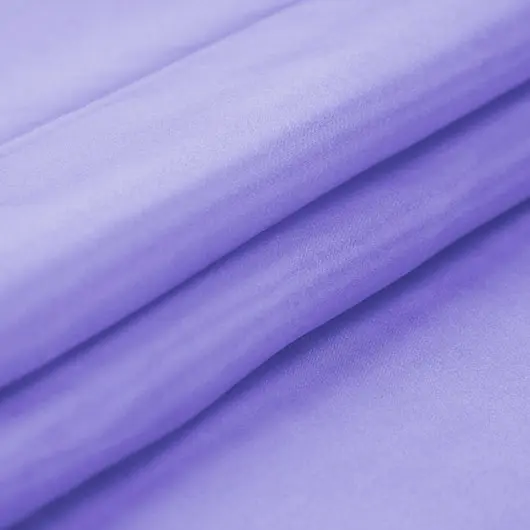
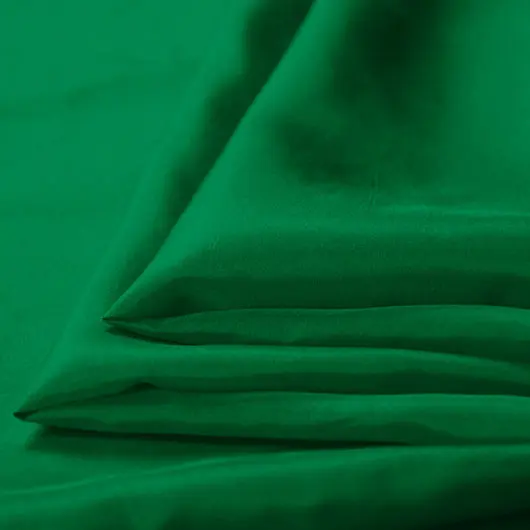
PHOTOGRAPHED FROM OUR STOCK
The cloth behind these terms
Unretouched photographs from our own floor. Colour varies between dye lots; the swatch card is the only reliable reference.
BUYING SILK · 100% MULBERRY SILK · FROM A CHINESE MILL
The strike-off is the whole game, and the base matters as much as the artwork.
Digital printing changed silk economics: a design that once needed screens and hundreds of metres can now be run from 40 metres per design. What it did not change is the physics — a print sits on a cloth, and the cloth decides how the print reads.
So the process is: choose the base, send the artwork, approve a strike-off, then run the bulk. We check the file for scale, repeat and colour separation before anything is printed, because the most common failure in silk printing is a file that was made for paper.
Short runs are viable, which means a capsule, a test or a made-to-order programme can carry its own print.
Charmeuse, crepe de chine, twill, chiffon, habotai — the base decides the drape, the print decides the look, and they are independent choices.
The printed sample is approved before the run. It is the print equivalent of a lab dip and it is not optional.
| Stage | Detail |
|---|---|
| Base | Any family in the catalogue, confirmed at quotation |
| Artwork | Vector or high-resolution raster; we check scale, repeat and separation |
| Minimum | 40 metres per design |
| Approval | Strike-off printed and approved before bulk |
| Hand | Printing can stiffen a cloth; the strike-off is where you feel it |
| Also | Rotary and screen printing for long runs and large volumes |
Prepare the file for cloth, not for paper. Print scale on fabric is unforgiving: a motif designed at screen resolution looks right at eight centimetres and falls apart at forty, and a repeat that was never built to tile shows a visible seam every repeat. Send the artwork early and let it be checked before it goes near a printer.
Decide the base by handling it, not by looking at it. The same print on a crepe and on a twill reads differently because the surface catches light differently, and the strike-off is the only place you can feel the difference. If you are unsure between two bases, strike both.
These search phrases all land here because they mean the same thing:
If you were looking for a different commercial question, the wholesale page covers programmes and the ready-stock page covers what is on the shelf right now.
Forty metres per design for digital printing. Very large volumes may be better on rotary or screen, which carries its own setup and minimum — we will say which is right for the quantity.
Vector artwork is ideal; high-resolution raster works if it is large enough for the print scale. Send what you have and we will check scale, repeat and colour separation and tell you if it needs work before printing.
It can. Ink sits on the surface and can stiffen a light cloth slightly, and a heavy coverage more than a light one. The strike-off is where you find this out — handle it before approving the run.
On any base in our range, yes. Twill and crepe de chine are the usual choices for scarves, habotai and charmeuse for garments. If you are unsure, we will print the strike-off on two bases.
The strike-off is approved first, then the run is printed, finished and dispatched. The quotation carries the date for your quantity; air or sea transit is quoted on top.
PHOTOGRAPHED FROM OUR STOCK
Unretouched photographs from our own floor. Colour varies between dye lots; the swatch card is the only reliable reference.
Tell us the quantity and the colour and we will quote it with a confirmed dispatch date.