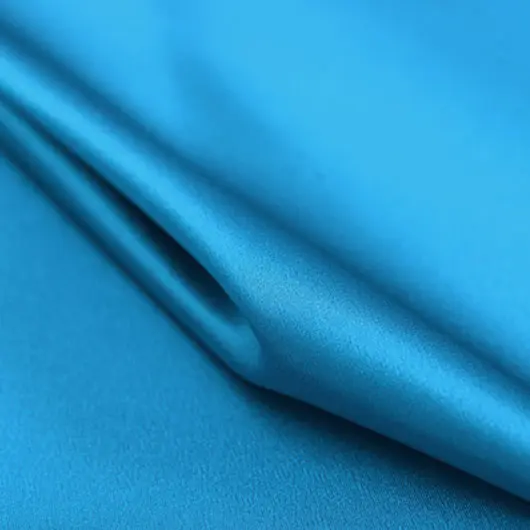
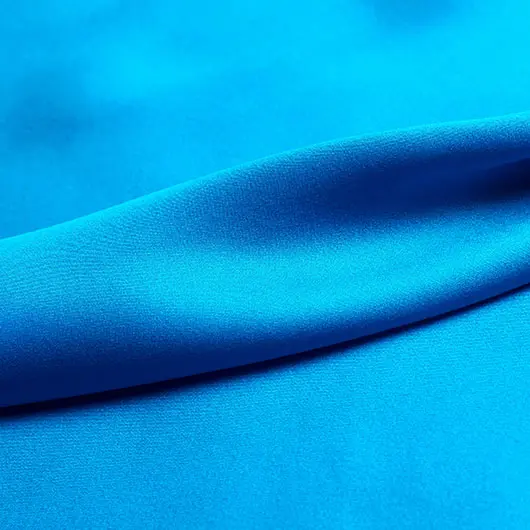
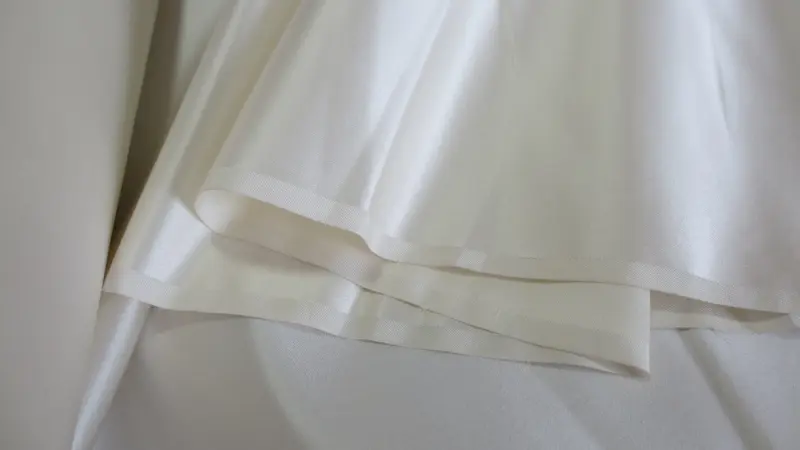
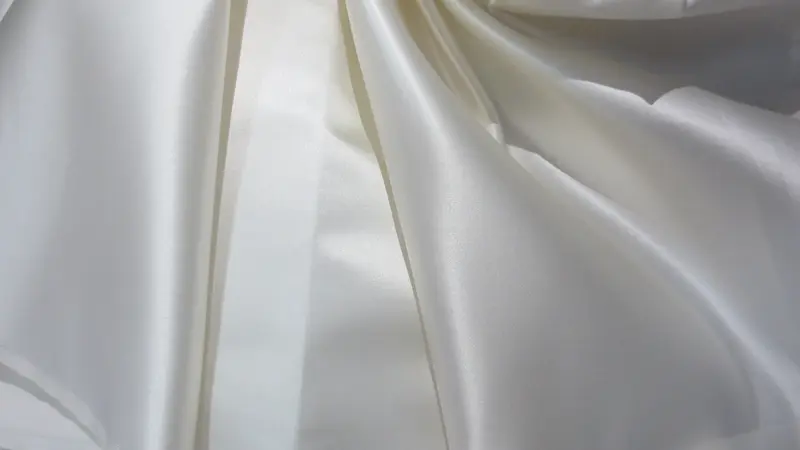
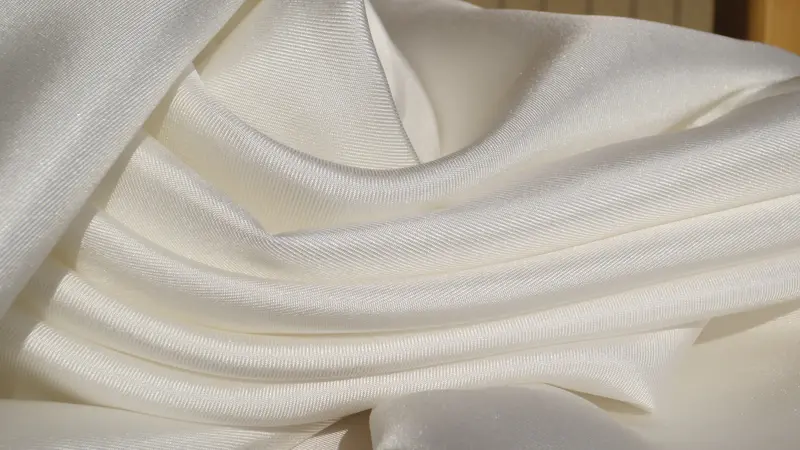
PHOTOGRAPHED FROM OUR STOCK
The cloth behind these terms
Unretouched photographs from our own floor. Colour varies between dye lots; the swatch card is the only reliable reference.
BUYING SILK · 100% MULBERRY SILK · FROM A CHINESE MILL
What changes when the mill answers the email instead of a trading company.
China produces the majority of the world's silk fabric, and most buyers reach it through a trading company that sits between them and the loom. That layer is useful when you need consolidation across mills, and expensive when you need a technical answer: a question about weft density or dye uptake goes out and comes back translated twice.
We are the mill. Questions go to the people who set the loom and run the dye house, which is why we can tell you the usable width and the momme tolerance before you place an order rather than after.
Width, weight tolerance, dye method and finishing are confirmed by the people who control them, not relayed.
A trading company earns its margin by consolidating. If you are buying one family in volume, that margin is a cost without a service attached.
The retained bulk sample and the lab dip stay with the mill that dyed the cloth, so a repeat order can be matched against them.
| Direct from the mill | Through a trading company | |
|---|---|---|
| Technical detail | Answered by the people who set the loom | Relayed, often simplified |
| Consolidation across mills | Not offered — one mill's range | The main reason to use one |
| Sampling | 1 m, any stock colour | Usually a swatch card |
| Custom colour | 40 m per colour, lab dip first | Dependent on the mill behind them |
| Price transparency | Quote states width, momme and tolerance | Often a single number |
Buying from China works best when you treat the time difference as a feature rather than an obstacle: send the question at the end of your day and the technical answer is usually waiting at the start of it. The failure mode is a vague question. "Is the quality good?" gets a marketing answer; "what is the usable width and the momme tolerance on this weight?" gets an engineering one.
On inspection, decide before you order who checks what and where. Cloth can be inspected at the mill before it ships, or at your warehouse after it lands, and the two are not equivalent — a claim is far easier to settle before the fabric has crossed a border. Say which you want and get it on the quotation.
These search phrases all land here because they mean the same thing:
If you were looking for a different commercial question, the wholesale page covers programmes and the ready-stock page covers what is on the shelf right now.
We are the mill. Predatex Silk Co., Ltd. is the legal entity and IM Silk is the trading name. The cloth is woven and dyed in our own operation, which is why we can quote the width and the momme tolerance on the quotation rather than after delivery.
It is not always. What China has is the full chain in one place — reeling, weaving, dyeing and finishing — which removes several handling and transport steps. The saving is in the chain, not in the silk; a heavy mulberry silk still uses roughly twice the raw material of a light one wherever it is woven.
Ask three questions that only a mill can answer: what is the usable width excluding the selvedge, what is the momme tolerance on this weight, and can I have a lab dip before bulk. A trading company will usually have to ask someone; a mill answers. Ask for a physical swatch rather than a photograph.
Stock colours dispatch in a few working days; air and sea transit is quoted against your destination and the confirmed dispatch date. Dyed-to-order runs need the lab dip approved before dyeing starts, and the quotation carries the date.
Yes. Tell us what the audit covers and we will confirm what we can show you and what documentation we hold.
PHOTOGRAPHED FROM OUR STOCK
Unretouched photographs from our own floor. Colour varies between dye lots; the swatch card is the only reliable reference.
Tell us the quantity and the colour and we will quote it with a confirmed dispatch date.